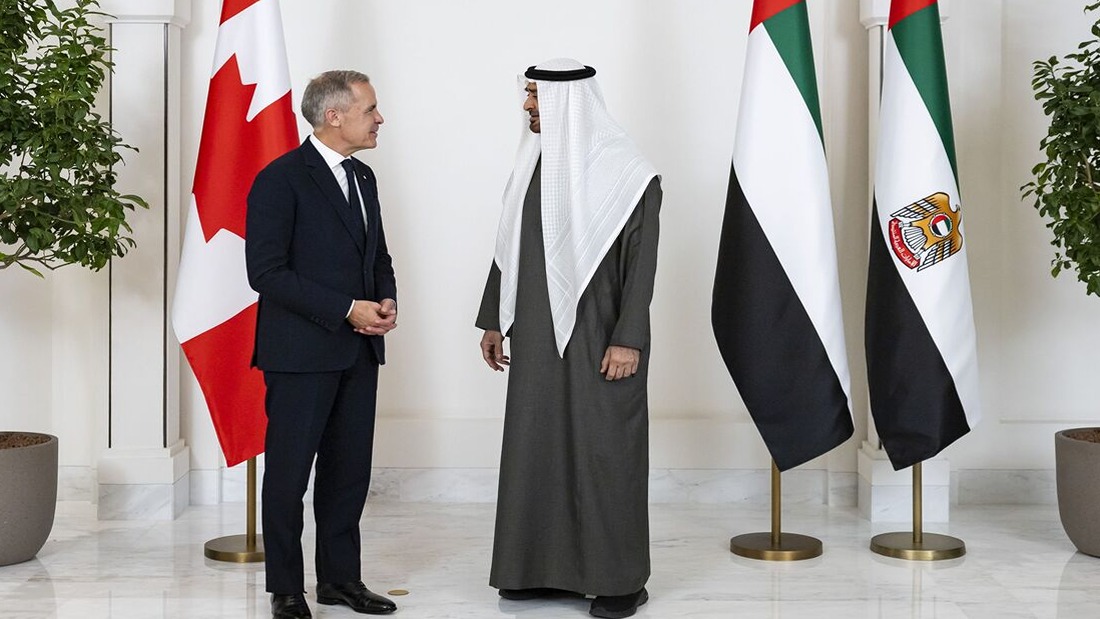
The United Arab Emirates has pledged up to US$50 billion in investment for Canada, marking a significant step in Ottawa’s strategy to diversify trade and capital flows away from heavy reliance on the U.S. market. The commitment followed a multi-day visit by Prime Minister Mark Carney to Abu Dhabi, where a series of long-term agreements were concluded across artificial intelligence, energy and mining. The announcement was made by the UAE’s Ministry of Investment and shared through a government statement during the summit.
Carney’s visit was the first by a Canadian prime minister to the UAE in more than four decades, underlining the renewed importance of Gulf partnerships in Canada’s foreign and economic policy. The deals form part of Canada’s broader ambition to double non-U.S. exports over the next decade and attract up to $1 trillion in new investment within five years.Since taking office, Carney has prioritised foreign capital attraction as a pillar of his economic plan. During his bilateral meeting with UAE President Sheikh Mohamed bin Zayed Al Nahyan, the two leaders signed a Foreign Investment Promotion and Protection Agreement, providing a framework to strengthen long-term investment flows between the countries.
Beyond the headline figure, the agreements signal a strategic alignment around future-facing sectors, with joint interest in AI infrastructure, clean and transitional energy systems, and critical minerals development. Officials say the partnership reflects Canada’s drive to reposition itself as a stable, diversified destination for global capital amid shifting geopolitical and trade dynamics.
UAE and Canada Capital Deal Reshapes Trade Strategy
Canada has signed a Foreign Investment Promotion and Protection Agreement (FIPA) with the United Arab Emirates, marking a major step in Ottawa’s push to diversify trade and investment beyond traditional partners and reduce dependence on the U.S. market. The agreement sets clear, fixed rules for Emirati investors seeking to operate in Canada, aiming to reduce regulatory uncertainty and create legal stability for long-term projects across sectors such as clean technology, engineering, artificial intelligence and digital infrastructure.
“Our agreements with the UAE will attract billions of dollars in investments into Canada, open new markets and opportunities for our workers and businesses, and create high-paying careers across the country,” said Mark Carney, Canada Prime Minister. Alongside the FIPA signing, Carney and UAE President Sheikh Mohamed bin Zayed Al Nahyan officially launched negotiations for a Comprehensive Economic Partnership Agreement (CEPA). If concluded, the deal could significantly reduce tariffs and regulatory barriers, strengthening two-way trade and investment flows.
The UAE, a $700 billion economy and a rapidly expanding global logistics hub, is being positioned by Canada as a gateway market for exports into the Middle East, Africa and South Asia. Key Canadian sectors expected to benefit include aerospace, agri-food, seafood and advanced manufacturing. Canada’s trade ministry estimates that a CEPA could potentially double bilateral trade from about $3.4 billion to $7 billion over the next decade, reflecting outcomes seen in similar agreements with Chile and South Korea. More broadly, the move signals Canada’s intent to build deeper economic ties with capital-rich Gulf states as global trade patterns shift and competition for strategic investment in energy, technology and critical minerals continues to intensify.
AI, Investment and Air Links Ties Deepen for Canada-UAE
Canada’s Prime Minister Mark Carney’s visit to the United Arab Emirates moved beyond policy announcements into concrete commercial planning, with pension capital, AI cooperation and aviation links emerging as central pillars of Canada’s growing relationship with Abu Dhabi.
During the trip, Carney held meetings with senior UAE business leaders, including the heads of major sovereign wealth funds and executives from G42, the country’s state-linked artificial intelligence champion. The UAE is rapidly positioning itself as a global technology hub, building what it describes as one of the world’s largest data centre clusters in partnership with US technology suppliers, while also expanding its international AI and clean energy footprint through XRG, the foreign investment arm of ADNOC.
Carney confirmed that Canada’s Minister of International Trade, Maninder Sidhu, will lead a high-level business delegation to the UAE in early 2026, focusing on artificial intelligence, infrastructure, agriculture and energy. The mission will also seek to draw UAE sovereign wealth funds to Canada for direct engagement with the federal government’s Major Projects Office, with liquefied natural gas, critical minerals and data infrastructure identified as priority investment areas.
In parallel, Canada’s major pension funds which collectively manage more than $2 trillion in assets will travel to the UAE next year to explore long-term investment opportunities across energy, infrastructure and technology platforms.Improved connectivity is also part of the economic push, with more direct commercial flights expected to launch between the two countries, boosting both passenger and cargo capacity and strengthening trade logistics.
The Canada-UAE Investment Summit, attended by Carney during the visit, saw several partnerships finalised. Montreal-based AI institute Mila reached a collaboration agreement with the UAE’s Technology Innovation Institute on advanced AI systems development. BlackBerry signed a cybersecurity partnership with the UAE’s Cyber Security Council, while Invest in Canada established a direct working relationship with the UAE Ministry of Investment to coordinate future large-scale projects.
Carney also used the summit to reaffirm Canada’s support for long-term regional stability in the Middle East through multilateral engagement. “This is about building Canada strong. We’re diversifying our trade, we’re finding new investors and we’re doing it on our terms,” concluded Carney.